January 31, 2011

Leadership — To be Felt; Not to be Seen


Organizations need people for what they can do for them and what they can mean to them. That need can be direct or indirect but one thing is certain: Organizations have no choice. In the normal course the higher the employee engagement, the better the organization’s performance.  There are six drivers of employee engagement: one, people—senior leadership, peers, culture and values; two, work—nature of work, motivation for work, and availability of resources; three, opportunities—scope for career progression, skill development via training and recognition; four, quality of life—balance afforded between work at organization and personal life; five, procedures—policies and procedures under HR; and six, compensation—benefits and rewards. It is these six drivers that influence people to engage, either positively or negatively, in work, which ultimately defines the return on investment. So, the question is what ensures heightened employees’ engagement and how is it accomplished? One obvious answer is ‘leadership’.

The moment we think of leadership what comes to our mind is ‘top-down’ leadership that is based on the myth of the triumphant individual. These leaders like the Welches, the Gateses have all become heroes. Our current thinking about leadership is so entwined with the notion of heroism that in the opinion of Warren Bennis, the distinction between “leader” and “hero” has almost become blurred. Today leadership is too often seen as an individual phenomenon. But in a shrinking world where technological and political complexity is increasing at an incredible pace, top-down leadership cannot suffice. However gifted the person at the top may be, the top-down leadership cannot all alone identify and solve the mounting problems nor can it build the many connections required to be made across the globe.

Leonard Bernstein once said, “The hardest instrument to play in a symphony orchestra is second fiddle”. It reveals that what is today needed in organizations is “great partnerships”— partnerships between employees and management where management has to play a “second fiddle”. It simply calls for collective engagement of all the employees. To cite an example: who built the varadhi—bridge to Lanka in Ramayana? Was it Rama – shouting commands, giving direction, inspiring the monkeys, leading the way and changing the paradigms? No, it was the monkey-force and their creative alliance with Rama’s need that built the varadhi across the ocean. So where does all this lead us? It tells us that nothing can be achieved by an organization “without the full inclusion, initiative and cooperation of followers”. It is through lifting others up that leaders find themselves lifted up i.e. their organizational objectives are achieved.

It is often said that Rama, unlike the many other kings of yore (why, even of today), is a Purva Bhashi i.e. it is king Rama who, unlike other kings first addresses his visiting subjects without waiting for subjects to address him. That is truly great of a leader. Rama is also described as: “Ramo Vigrahavan dharmaha”- Rama the embodiment of Dharma. He, as a king, meticulously practiced the essence of the saying from the Atharva Veda: “vacham vadata bhadriya” – words spoken should foster welfare. It commands that the communication of a leader should always be loaded with pleasant words leading to positive outcomes.

Being driven by the philosophy of ‘dharma’, Rama even sacrificed his life with Sita to carry out his duties as a king, believing that for a king what matters is his kingdom and its people. That is why it is said that it is not Rama, but the king of Ayodhya, who abandoned Sita in the interest of his kingdom. That is how Rama displayed leadership more by action than by exhortation. True to Kalidasa’s proclamation about leadership, Rama’s kingship made every one of his subjects think to himself: “I am the especial object of the Royal care”, for, like the ocean that receives without differentiation countless rivers, the king neglected the interests of none.

Rama ensured that his leadership was felt by his subjects and in turn commanded “people’s respect”, which is essential for any kingdom to be in peace. The quintessence of leadership is aptly captured in the Ramayana in the stanza: “Truth, justice, and nobility of rank are centered in the king; he is mother, father, benefactor of his subjects.” No one can deny that these observations are equally applicable to the modern day leaders too—for that matter, more intently than in the past.

Today organizations are slowly but surely evolving into federations, networks, clusters, etc., where the top-down leadership has simply become obsolete.  What leadership therefore should exhibit is “far more subtle and indirect form of influence” over the followers. They must learn to appreciate the intellectual power, capital, and human imagination since it has almost replaced the capital as the critical success factor in a globalized economy. The Tao tells us: “When people lack respect, trouble follows”. The only sure way for a leader to command respect from the work-force is to respect employees’ intellectual capital and values and align them with the goals of the organization. That is the only way by which leadership can create an impulse, an urge in others to do something, which the leader desires that they do. All this calls for a totally new set of skills that can make leadership effective without making a bizarre exhibition of it. 
 GRK Murty

January 27, 2011

Nobel in Economics: Prize for Practical Wisdom


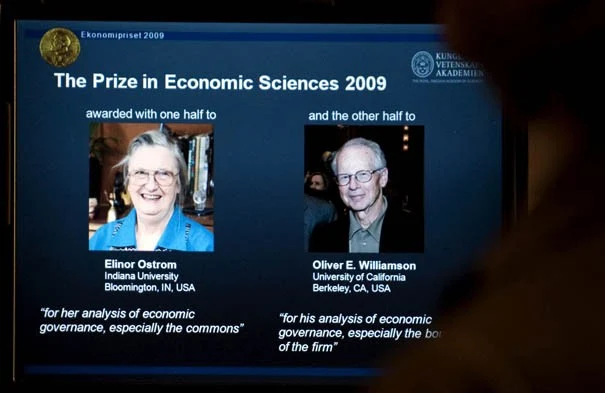
The Nobel Prize in Economics to Ostrom and Williamson—who have by their independent research taken economics beyond the traditional analysis of market prices by establishing ‘economic governance’ as a field of research—has come at the right time when the world is entangled in governance issues that have not only led to the collapse of organizations but also to worldwide contagions.

Neo-classical economics textbooks proclaim that markets endowed with private property rights and contracts are better equipped to deliver wonders—efficiency and equity. But in the real world, as is incidentally being experienced amid the ongoing global economic crisis, it does not happen that way, at least always. Even the prophet of market economy, Adam Smith, is perhaps aware of it when he said: “Creating harmony between the pursuit of self-interest and the pursuit of social welfare depends on the constraints on self-interest.” But the scope for the operation of such a ‘constraint’ on man’s behavior appears slim: for ‘Man’, as enunciated by grandsire Bhishma in The Mahabharata, is a slave to money—arthasya purusha dasah. The ongoing world economic crisis is, perhaps, a vindication of this prophecy.

Fortunately, there are off-beat researchers of modern day who have analyzed as to why the world looks the way it does—different from the ideal world found in classical textbooks—and explained as to what works in it. It is to two of such researchers—Elinor Ostrom of Indiana University, Bloomington, US, and Oliver Williamson of University of California, Berkeley, US—that the Nobel committee has awarded the Nobel Prize in Economic Sciences for the year 2009. They share the prize for their separate research into economic governance—the rules by which people organize, cooperate, relate and exercise authority in companies and economic systems—that “advanced economic governance research from the fringe to the forefront of scientific attention.” The committee observed that their research revealed how economic analysis could explain most forms of social organization.

Ostrom, the first woman to win Nobel in Economics, is currently the Arthur F Bentley Professor of Political Science, at Indiana University, Bloomington. Her pioneering work mostly concerns the economic governance of the common pool resources—managing common resources such as pastures, woods, lakes, and fish stocks. Her research “has challenged the conventional wisdom that common property is poorly managed and should be either regulated by central authorities or privatized,” said the Nobel economics committee. Her findings, though sound commonsensical, are eye-openers, for they challenge Garret Hardin’s “The Tragedy of the Commons”—a living expression of neo-classical thinking—through their revelation that common resources are better managed from the bottom-up by user-associations than by the governments or the private sector. Ostrom went out to the field to study what people and communities are doing differently, and drawing new insights from it, proposed a new architecture of governance, which she dubbed ‘polycentric governance’. Based on her field research, Ostrom has prescribed new ‘design principles’ that could be used by people, communities, and societies facing real-world problems in managing local common pool resources: one, clearly defined boundaries; two, adapting rules regarding the appropriation and provision of common resources to local conditions; three, collective-choice arrangements; four, effective monitoring by monitors who are part of or accountable to the appropriators; five, a scale of graduated sanctions for resource appropriators who violate community rules; six, cheap and easy access mechanisms of conflict resolution; and seven, recognition of the self-determination of the community by higher-level authorities. 
Her co-winner, Williamson, currently the Edgar F Kaiser Professor Emeritus at the Haas School of Business, University of California, Berkeley, is a pioneer in the multi-disciplinary field of transaction cost economies and has been awarded the Nobel “for his analysis of economic governance, especially the boundaries of the firm.” Williamson “developed a theory where business firms served as structures for conflict resolution”. He has argued that hierarchical organizations, such as companies, represent alternative governance structures, which differ in their approaches to resolving conflicts of interest. His ‘transaction cost theory’—developed based on the opportunistic behavior of agents who can renege on their commitments, bounded rationality of agents and asset specificity, where assets are only valuable in certain uses and certain economic relationships that offer a scope for the parties transacting with each other to engage in ‘holdup behavior’—indeed highlights the nature of real-world market organizations. It argues that “large private corporations exist primarily because they are efficient. They are established because they make owners, workers, suppliers, and customers better off than they would be under alternative institutional arrangements.” It also clarifies that “when corporations fail to deliver efficiency gains, their existence will be called into question,” which means firms cannot grow infinitely either. Admitting the fact that corporates are better equipped to handle the drawback—haggling and disagreement—associated with markets by virtue of their authority to ‘mitigate contention’, Williamson warns that the same authority can as well be abused. It also emphasizes the limited ability of people to make perfectly informed decisions, besides the propensity of some to act opportunistically. His research findings recommend that it is better to control such behavior directly rather than through policies that restrict the size of the corporates. 

In sum, his insights help us understand better a broad range of organizational compacts such as the choice and design of contracts, ‘information impactedness’, corporate financial structure, the function and operation of political systems, and the size and scope of firms—the question of a firm going for vertical integration as defined by the scope for lowering the transaction costs; why some activities are carried out by large corporations, while others aren’t; and why big firms come into existence more frequently than is predicted by the neo-classical theory.

Interestingly, the Nobel award is a good thing to happen to Ostrom and Williamson who have by their independent research taken economics beyond the traditional analysis of market prices by establishing ‘economic governance’ as a field of research that has “greatly enhanced our understanding of non-market institutions,” that too at a time when the world is entangled in governance issues—failure of boards of directors to moderate excessive compensation or bonuses that encouraged excessive risk-taking, leading to not only the collapse of organizations but also worldwide contagions. Thus, their research highlights once again the need for a constant vigil over “man’s slavery to money”, as reflected in his behavior.

- GRK Murty

January 17, 2011

autogenic training

http://antaryamin.wordpress.com/category/theoretical-knowledge-are-hindu-gods-real/

Gangetic plains of yesteryears.  Flower trees are shedding their blossoms like little showers falling from white clouds. They are hiding  behind lush green leaves enchantingly.  Skipping deer, dancing peacocks, and the scintillating songs of ‘Koels’— Koel ki kuhu kuhu, Papihe ki pihu pihu have all made the scene manohar—beautiful.                 

In the quietude of such serene forest, hermits are reflecting upon the amazing powers of the mind.  A seer realizes that the mind is endowed with tremendous speed and an unobstructed entrance to the remotest corner of the universe.  It goes on desiring myriad objects, thinks its own thoughts, spins its own doubts. Marvelling at the sheer strength of its imaginative power, they start chanting hymns glorifying its omnipotence —

That which guides men’s deeds as the charioteer guides movements of his horses, that which is speedy and deathless and which inhabits the hearts, may that mind of mine be absorbed in noble thoughts.

What a profound thought!  No other hymn could perhaps better describe the enormous fund of energy possessed by the mind and the possibility of harnessing that energy for doing any kind of job.  It is in appreciation of its abhorrence for vacuum, seers started feeding it with virtuous reflections, for such auto-feeding was found to keep the mind in good stead.  Mind you, all this was prior to the modern psychologists coming out with words like sublimation etc.  But these simple thoughts were lost in transit.

Today, psychologists say: ‘as a man thinketh in his heart, so is he’. Of course, the present day computer analogy coupled with the premises of Cybernetics reveals that the brain functions simply as it has been programmed.  The quality of picture images that we paint and ‘run’ within the deeper recesses of the mind is the actual software through which we experience the real world.

Believing in this premise, let’s auto-feed our mind with affirmations that matter most in today’s life and see if it will make any difference:


For today, I will be as friendly as I can be with the people I work with.  I will   treat them as if they were responsible for keeping me in my job and be grateful they are there. 

For today, I will try to see the good in every situation and will look for something to praise in every person who works with me

For today, if I correct someone, I will do it with as much grace as if I were the one being corrected.

For today, I am not going to insist that everything I do be perfect.  I will do what is in front of me with competency but not painful compulsion.

For today, I will feel happy I am at work, alive and well and not in a combat trench.

For today, I will not have any expectations about how I should be treated.  I will just be glad I am who I am.

For today, I will not worry about “What is ahead for me”.  I will think only about what I can do to help out in every situation.

Dr. Emile Coue once said that when the ‘Will’ and ‘Imagination’ are at conflict, it is always the imagination that wins.   Therefore, repeated reinforcement of positive thoughts would obviously strengthen that imagination.  It might make all the difference.  If not anything, it would certainly save wear and tear of our most valuable asset – Peace of mind.

- GRK Murty

January 14, 2011

Towards excellence...

http://www.flickr.com/photos/rahulsadagopan/


Yadeva Vidyaya Karoti,
Sraddhaya, Upanisada,
tadeva Viryavattaram bhavati

  Chandogya Upanisad 1.1.10

Whatever work is done with knowledge,
through faith and backed by meditation,
that alone becomes most effective.

Vidya—knowledge—the theoretical and conceptual clarity of subject is the primordial requirement for efficiency in work.

Knowledge, sans Sraddha—faith—remains static, remains as a mere possession.  Sraddha evinced by the seeker alone energises the Vidya and ensures its transformation into Karma—action.

Swami Vivekananda once said: “What makes the difference between man and man is the difference in this Sraddha and nothing else.  He who thinks himself weak, will become weak.” Faith simply generates ‘belief’. And belief in one’s knowledge-power alone makes things happen.

“Sraddha Sraddhamayoyam purso yo yat Sraddha na eva sah” – “Man consists of Sraddha.  Whatever be the measure of his Sraddha, that will be the measure of his life as well” - says the Gita. Therefore, one need to acquire Sraddha—this deep faith in oneself, so that one may develop into a dynamic character.

‘Knowledge’ can be imparted but no training can impart SraddhaSraddha has to be captured by oneself.  Sraddha is more of a spiritual value. It moves a man from within. Its simply a reflection of the richness of the personality.  It imparts an artistic quality to one’s life and work.   Faith in oneself, in the divine within, is the greatest source of enrichment of a personality.  Such a person works out of the fullness of one’s heart.

This Sraddha, however, needs to be properly channelised.  Upanisad—calm meditation—is the one thing that helps in properly directing and disciplining one’s knowledge. It makes one’s actions meaningful, Sarvopakari—good for everyone. 
http://www.flickr.com/photos/projupiter/

This flow of the man’s energy from faith, Sraddha through knowledge, Vidya to action, Karma is the basis of efficiency. But this flow is prone to suffer shutdowns due to ups and downs in the emotional life of the worker.  Inner disintegration or want of integration results in outer disorganisation.  This automatically lowers the efficiency. On the other hand, Upanisad—meditation helps in  arresting these disturbances. Meditation gathers mind into itself.  When mind takes leave of the body, thought becomes crystal clear.

Upanisad—meditation, fortifies the worker and his work. That fortification scatters fearlessness, love and peace all round. It simply unites ‘philanthropic efficiency with philosophic calm’.  That alone makes ‘governance’ a   Sarvahit—‘omni-benefactary’.

A ‘governance’ that is driven by these values of Vidya, Sraddha and Upanisad can simply excel in its effect, efficiency and acceptability.

What a blessed insight!
 -         GRK Murty

January 11, 2011

Businesses: Be Aware!

No Karnas in Navabharat


“If you cross over, you will be the King; Yudhishthira, the crown prince of Pandavas will stand behind you holding the royal fan; Bhima will hold his great white umbrella; all the Pandava allies will pay tribute and touch your feet,” Krishna thus urges Karna while lobbying for the success of the Pandavas in the forthcoming war. Indeed, Krishna begins his lobbying by revealing the secret of Karna’s royal birth—of his being the eldest son of Kunti. Of course, it is the nobility of his character that Karna does not fall for it; nor does he ever reveal this conversation to anyone as, of course, sought by the parting Krishna.

Any wonder, if modern-day lobbying fades before Krishna’s? Of course, that is not what matters most now. What really matters is: What is this ‘lobbying’ that is today rocking India and Indian businesses wildly? And, how has it become so deep-rooted in managing human/business/political affairs for ages? Dictionary defines lobbying as “a form of advocacy with the intention of influencing decisions made by the government by individuals or more usually by lobby groups”, which includes all attempts to influence legislators and officials whether by other legislators, constituents, or organized groups. And a ‘lobbyist’ is a person who tries to influence legislation on behalf of a special interest or a member of a lobby.

Pieter Bouwen, author of the paper, “A Comparative Study of Business Lobbying in the European Parliament, the European Commission and the Council of Ministers,” argues that lobbying activities of business interests need to be conceived as an exchange relation between two groups—private and public actors—of interdependent organizations. He also avers, “It is a mistake to regard business lobbying as a unidirectional activity of private actors vis-à-vis the public institutions, for the public institutions too need to interact because they need close contacts with the private sector in order to fulfill their institutional role.”

The interaction between private and public organizations is conceived by sociologists as a series of inter-organizational exchanges, mostly driven by the ‘resource dependence perspective’ proposed by Pfeffer and Salancik (1978). According to this model, public institutions are not internally self-sufficient and hence need resources from the environment, and therefore have to interact with those organizations or groups in the environment who control the resources they need. It is in the context of decision-making process that the private and public actors become interdependent, for they need resources from each other. Here the exchange is mostly in terms of ‘access’ to the public institutions that are known as agenda-setting and decision-making bodies for private organizations, and in return for this access, public institutions demand certain goods that are crucial for their own functioning. These goods are called ‘access goods’, which are mostly concerned about three kinds of information: one, expert knowledge—information needed to understand the market; two, information about the encompassing interest—information on the aggregated needs and interests of a sector in the whole market; and three, information about the domestic encompassing interest—information about the aggregated needs and interests of a sector in the domestic market.

This being the apparent logic behind the lobbying behavior of business groups, it is needless to say here that the large players who have enough resources to undertake individual lobbying gain greater access to public institutions, while the smaller actors have to often rely on collective action to gain any political advantage. Interestingly, economist Thomas Sowell, defending corporate lobbying as simply an example of a group having better knowledge of its interests than the people at large do of theirs, gives an altogether new connotation to the art of lobbying. Back home, we have Abhijit Sen, member, Planning Commission, who is reported to have said: “To some extent, it will reduce corruption.” In a way, Sen echoes the logic behind lobbying traced above, when he says, “In a country that lacks world-class research centers, officials have little choice but to rely on the fact-filled presentations that the lobbyists provide,” if the press reports are to be believed.

Now, thanks to the continued bedlam in the Parliament for the last 15 days which has brought to the national scene the whole glamour (or, is it the murkiness?) of Washington-type of lobbying that recently made deep inroads into India—the business of persuasion to garner influence through various games: planted stories and PowerPoint presentations—that too, in a big way, its positive fallout being: with the kind of liberalization of economy that we have set in motion, we cannot but learn to live with lobbying.

Some critics, albeit rightly, argue that some of the practices of lobbyists are within the law, while others comment that it can be harder to counter these tactics. So, what the current turmoil generated over lobbying now calls for is: more scrutiny. But before that takes a formal shape, what the leaders, be they from the business or political field, need to realize is that there is no other known way of protecting one’s privacy than being always clean. For, being clean and ethical minimizes the need for the verb ‘hide’.
 
But how difficult it is to be always clean!

GRK Murty

January 06, 2011

2011: Anticipated Global Food Crisis

Agriculture is the lynchpin of India’s food and livelihood security. For, it still provides employment to around 52% of the workforce, though its share in India’s GDP (at constant prices of 2004-05) slid from 18.9% in 2004-05 to 15.7% by 2008-09, while growth rate itself fell from 4.7% in 2007-08 to 1.6% by 2008-09.

Against this backdrop, and particularly the known quantitative and qualitative status of undernutrition and malnutrition prevailing in our country being what it is, the recent warning of the Food and Agriculture Organization (FAO) of the United Nations that “with the pressure on world prices of most commodities not abating, the international community must remain vigilant against further supply shocks in 2011,” is sending shockwaves.

For, when prices of food commodities spike in global markets, they tend to transmit to domestic markets, particularly when markets are integrated—a stage towards which India is currently heading; and it is the consumers in the developing countries that are worst-hit, as they spend a high share of their incomes on acquisition of food, that too, having no or little options in their food choices.

Now the question is: What should India do in 2011 to obviate the forecasted crisis? Of course, as the Steering Committee on food and nutrition set up to advise the UN Committee on food security observed, India must draft and execute “a comprehensive coordinated approach, not piecemeal approaches, to tackling chronic, hidden and transitory hunger.”

Fortunately, we have suitable policies already in place, but what is needed is: political will to implement them in letter and spirit. The first policy that comes to mind for immediate execution is the recommendations of the National Commission on Farmers, which emphasized the importance of “imparting an income orientation to agriculture” by affording water and nutrients, timely credit and assured and remunerative marketing system that ultimately result in higher productivity per unit of land.

The mission-criticality of this simple requirement can best be appreciated only when one is aware of the basics of Indian agriculture. More than four-fifths of India’s total operational holding of 1,077.1 lakhs fall under the category of small and marginal farmers consisting of less than 2 ha. Essentially, every farmer is a risk-taking entrepreneur—even today, the entrepreneurship of an Indian farmer is a gamble on the monsoon system. Besides, they also face the risk of spurious inputs such as seeds and pesticides, pest and disease attacks, and inadequate/untimely credit supply, coupled with procedural hassles from the banking system and price uncertainties.

And the small and marginal farmers are the worst victims of all these risks, for they do not have the wherewithal to micromanage these innumerable risks; nor do they have the asset-backing to stay put with the consequences of any of these risks—particularly, the consequences associated with the risk of extremities of weather, like the one the state of Andhra Pradesh suffered in the current kharif season.

So, what immediately needs to be done is to build risk-mitigation mechanisms in an integrated way into the system. It, of course, calls for a multi-pronged strategy to address both covariate and idiosyncratic risks: one, macro level agricultural insurance system to be strengthened, besides making it meaningful; two, encouraging local collective group insurance initiatives; three, so streamlining the credit delivery system that it adopts a flexible and cyclical credit system in sync with weather behavior; four, institutionalizing the price support mechanisms and procurement for greater transparency; and five, creating a reliable and well-regulated market infrastructure. So far as the policy initiatives for providing ex post risk-related relief are concerned, a distinction needs to be made between normal risks and risks that are rare but having high consequences for individuals over larger areas, and importantly, institutionalizing these measures to limit the scope for corruption. 

Are we then ready to plunge into action—of course, right action?

- GRK Murty

Recent Posts

Recent Posts Widget